Monday, November 16, 2009

F-35A wip update

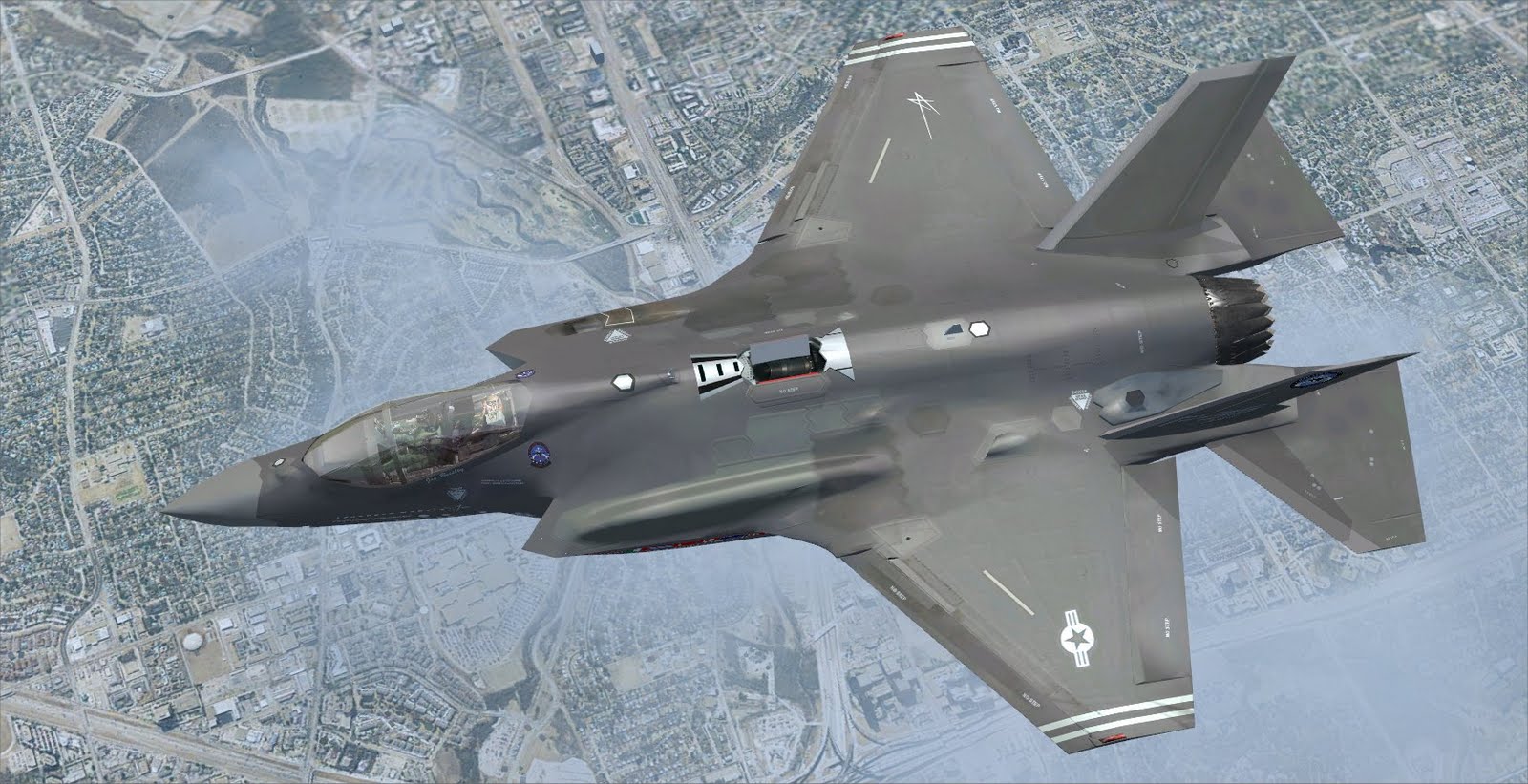
F-35 AA-1 external model is almost finished

While some aviation enthusiasts do not like its shape very much, I have to confess I like it. It looks modern and functional... but then, I have also to confess I liked also the "Fugly Fighter" X-32...

I'm still not happy with the reflections on some areas of the fuselage... some tweaks are needed - probably there is something I should fix in the fuselage normal map.

Refuel receptacle doors opening test - passed! F-35B and F-35C do not have this receptacle, but they feature a retractable probe nearby the canopy.

Weapon bay doors opening test - passed. As shown in this image, the F-35A can carry two AMRAAMs and two 2000lb JDAMS internally. Also, six removable pylons can be mounted for external loads.

Testing the flight model with a 4g turn. Flight model is still preliminary - while not perferct it is a good start.

Finally I found the time and mood to do some (much needed) progress with the F-35. There are a couple of annoying glitches in the external model which require some ironing, but as you can see in the screenshots above, the external model is done. I have a couple of "spare" animation sequences to be assigned - but I'll be leaving these for the finishing touches. The main priority is the completition of the cockpit, which is far behind the schedule. But, you know, I also have a "real" job and a social life :-)
By the way, I've just seen the first pictures of the real F-35 AF-1 bird (the first "weight optimized" plane)...and I have to say I am slightly disappointed as I expected a flashy painscheme (that I would have added to the package) while the actual plane took off with many areas still in their "native" acid-green primer color - which I'm not sure makes much sense for my FSX model.
Also, I've read that BF-1 (the first VTOL bird) has been transferred to Patuxent River NAS for a series of tests that will culminate in the first vertical landing. Cool stuff.

Wednesday, November 11, 2009

Javier Fernandez releases v2.0 of his oustanding carrier package.

Nimitz V2.0 features underway replenishment visual model (and many other improvements including steam effect for catapults)
I just wanted to share the word that Javier Fernandez has released version 2.0 of his outstanding carrier package for FSX. It is really a must-have for every FSX user, as, within the limits of FSX, it is a practically perfect rendition of a Nimitz class carrier. Includes various deck configurations and dozens of easter eggs: freeware (and most payware) add-ons do not get much better than this. And it is fully Acceleration compatible.
As for my own projects, I have to confess I did not work too much on them recently for two reasons: one is the lack of time and the other is the release of some outstanding videogames on the Xbox 360 (Fifa 2010, Forza Motorsport 3 and Call of Duty:Modern Warfare 2) which are absorbing most of the time I spend at home. I will make a post about the status of the F-35 project in a day or two.
EDIT - I forgot to say that the file is available at www.flightsim.com and the ships are configured as "proper" ships - this means you need AICarriers (or a bgl file that contains routes for them - some are available at sim-outhouse)

Friday, October 16, 2009

Some more work-in-progress screenshots


Above are some screenshots taken during F-35 AA-1 flight testing nearby Edwards AFB. It is very hard to judge what would be the right behaviour of the real plane - but I am doing my best. Definitely there will be some tuning needed during Beta testing. Unfortunately I had not much time to work on the F-35 in the past few weeks - I am doing what I can.
Status of the project is as follows:
  • External model: AA-1 is 99% complete. Some minor tweaks to the afterburner are needed, and the emergency arresting gear is not modeled. Also, the internal should host "mock" ordnance, but at present they have "real" JDAMs (recycled from the Tomcat). The final package will most probably include the AF-1 (weight optimization) model and a final F-35 (probably USAF training unit).
  • Internal model: most of the "hard" part is done. I am having some difficulties finding good hi-res pictures of the canopy frame. Basically, front panels are done - but the MFD needs some more work. Side panels are 10% done but they are not really difficult to model. If I will find the time the internal model could be completed in a week or two.
  • Flight model: the current one needs some work but I think it is a good start

At present - it is likely that the Beta version will be ready in early November... later than I initially thought...but I am doing what I can with the time I have :-)

Sunday, October 4, 2009

The real India Foxt Echo


This is me in front of the Socata TB.9 Tampico I-IAFE of the Genova Aeroclub, during Genova Air Show 2004. This is the only time I remember in which the public was allowed to get into the parking area of the Sestri airport. So I took the chance to take picture with my old friend :-)


Another view of the I-IAFE, on the back there are the hangars of the Piaggio Aero Industries, where the amazing P.180 is manufactured.


And this is the Aviamilano P.19 Scricciolo I-GAGI, on which I logged roughly 10 hours. It was cheaper than the TB9, but it was also a significantly older machine. It was also much fun to fly, in my opinion, as its rough cockpit gave you a strong "I am flying" feel, rather than the TB9 that felt like "I am driving a modern compact car" :-) Some days ago I discovered (thanks to google) that it has been acquired by a member of the CAP Lazio and will be restored to flight conditions. By the way, basic P.19 was a taildragger - but could be asily modified to tricycle, as I-GAGI was.


When I started this blog, one of the hardest things was to chose a name for it. I admit IndiaFoxtEcho was not a bright choice. It it the "shortened" callsign of I-IAFE, the plane on which I spent most hours during my days as student pilot at the local Aeroclub. It is also the plane on which I did my first solo flight in 1992.

While I had to sacrifice some things, like the "traditional" European-trip vacation that most people do in the summer between high school and university, I owe the fantastic experience of earning the Private Pilot Licence to my parents.Well,in a broader but more exact sense, I owe them everything. They are hard working people who supported me in everything I wanted to do, and after many years spent working they are currently enjoying retirement. The PPL was expensive and we surely were not a rich family.

I quit flying few years later for several reasons, main one being the money. Flying is a very expensive hobby. And the more I did it, the more I wanted to make new experiences, fly other planes and see other places, but I could not afford more than being a "sunday pilot". Takeoff from Sestri, go to Portofino then back to Sestri. And I could not afford to try more complex and more expensive planes. So, I had to admit that at some point I got bored. But I do not regret anything. Getting a pilot licence is one of the things I always wanted to do, one of those things you want to do before you die. It was great, I am still proud of "eagle" pin and I am grateful for having had this opportunity.

At the time I quit, I logged 52 hours, flying TB-9, PA-28 and P.19. Apart from Genova Sestri, I've also landed and took-off from Albenga, Sarzana Luni, Pisa, Lucca and Cuneo Levaldigi.

Now, in order to give some sense to this post (apart from the self-celebrating amarcord), I wanted to share with you three "lesson to be learned" I took when I was a student pilot:


Lesson 1 - Pride is dangerous.

Being only 165cm tall I am definitely a short person. Which, when you are 18 years old, it is a fact you should have accepted. But I did not. So, when I was flying the P.19 I was advised to use a small cushion so that I could operate the pedals in a more comfortable way. Of course I refused the cushion, which was kind of a symbol of the fact I was short. Fact is that I was not comfortable, so one time it happened, during one flight, that one of my legs "fall asleep" (don't know the proper English for it - hope you get what I mean). Result: when landing, just after touchdown, the plane steered abruptly and I could not correct it as I could not move my leg. Good thing there was the flight instructor.


Lesson 2 - Trust the procedures

One problem you may have if you are a GA student pilot is that if you home airport has a big unobstructed runway, you are not really used to smaller ones. Albenga has not a small runway, but has a small hill on its side that, in case you are not making a straight-in approach from the sea, forces you to make a higher pattern than the one I was used to to at Sestri (which is at sea level and all patterns are done 1000ft over the sea). So, I was slightly afraid to be low...and overshoot the 1500ft (if I remember right) reccomended altitude. Result: I was very high at landing, hence very fast and I had the plane floating a lot over the runway. And I touched with a harder-than-usual landing almost in the mid of the runway. I should have declared a missed approach and retry.


Lesson 3A - Flight must be carefully planned/1

That is, look at the charts carefully and think ahead of what you should expect. I was flying solo from Sestri to Levaldingi, which in VFR basically means: follow the highway from Genova to Savona, then from Savona to Fossano. The issue was I had not planned how to reckon Fossano from the other towns (neither visually nor with a VOR reading). So I missed it, and while I was trying to understand where I was I got disoriented in the middle of the Piedmont countryside. Visibility was decreasing, so I decided to go back to Genova - which was a wise decision - albeit I had to cross the mountains with marginal VFR conditions - but I intercepted the highway to Savona and then I got back safely.

Lesson 3B - Flight must be carefully planned/2 (and you should look around you)

That is, look at the approach charts carefully. While planning your flight,pay particular attention to obstacles around airports you don't know - like high voltage lines, even if they are not close to the path you think you will follow.
In this case I was flying with my instructor (cmdr.Sincich) to Sarzana Luni. It is mainly a Navy helicopter base, with a small runway. Much smaller than Sestri. So, while landing, I was completely focused on the runway itself, and did not notice the high voltage lines. When the instructor warned me,we were not really close to them and there was no real danger. But I still remember this episode as I my attention was so completely focused on one thing (the runway) that I was not looking at anything else.

Flying was a great experience that marked my life forever.

P.S. As for FSX, F-35 development is slowing down due to lack of time. In these days my job is absorbing much of my energies. I'll post an update asap.
EDIT: Forgot to say that all of the episodes above happened almost 17 years ago...

Saturday, September 19, 2009

Some WIP hi-res Lighting II screenshots


Above are some screenshots of the F-35 AA-1 taken while I was testing the flight model. It is pretty hard to tell if it is "right", as, obviously, Lockheed Martin test pilots keep on saying it is an oustanding aircraft with excellent performance and maneuverability... but on the other hand, many "experts" in the internet are extremely critical on the plane performance - and the whole JSF project (I guess some of that hate comes from the fact that the F-35 will replace the F-16 which is an extremely successful and popular model)...
Anyway, I am pretty happy with the flight model. It needs some work but it is a good start.
The cockpit is suffering some delay... but I think it will be ready in 2-3 weeks.

Thursday, September 10, 2009

A Couple of F-35 Screenshots


Above are two in game screenshots of the F-35A Lighting II project I am working on. As you can see, the external model is almost complete - there is some minor "cleaning" to be done here and there, but it is done. While it is an highly detailed model, the graphics performance is not bad - in fact it is slightly better than the Tomcat. At present, the model depicts the AA-1 development bird, meaning the first "F-35" (and not X-35) even built. At the moment I am writing it is also the only CTOL bird actually flying, as all the other prototypes undergoing flight test are F-35Bs (VTOL). The only major "artistic licence" so far is that the if you open the weapon bays, you can see two AIM-120 and two JDAMs - but all the pictures I've seen so far of the AA-1 were showing mock ordnance.
The design of the real AA-1 has been subject to major weight-saving oriented improvements, so that the AF-1 and following CTOL prototypes will have a number of design changes. While, at present, AF-1 has been "rolled out" several months ago there are not many pictures of it on the internet, but its first flight should not be too distant... so that more information will be available - the plan being, of course, add the AF-1 to the package (or a "production" model). A third model would be a production model with external loads (there are pictures of a BF bird on the gorund with a pretty impressive loadout).
At present, my project will be focused on the F-35A - and my current target is complete the AA-1 model. While the F-35B (VTOL) is an extremely interesting machine, I am not currently working on it - mainly because IRIS is working on such model and because I prefer quality to quantity - considering I am a one-man team it is mandatory to keep the size of the project reasonable.
While it may not be evident at first sight, the F-35B fuselage is much different from the F-35A.Nose, wings and tails are almost identical - but almost everything else is different.
On the opposite, the CATOBAR F-35C fuselage geometry is close to the F-35A (main differences being the modifications to the nose gear, refuel probe and tail hook) but the wing is completely different: it is much bigger, and has a folding mechanism and spoilers.
So, making the -B and -C models starting from what I have would be surely doable - but it would require some major redesign of several areas so, for the moment, I am sticking to the F-35A - and I will do my best to achieve a good quality level on that before making any further step.

Monday, September 7, 2009

Firefighting and spectacular flying

Fire on Monte Moro, over Quinto and Nervi - at the Eastern limit of Genoa. Due to the exposure, this picture is overly dramatic. The fire is very large and quite close to the houses, but thanks to the hard work of the firemen, there has been no risk for the population.


At the moment I am writing, two Canadair CL415's and one S-64 Skycrane are flying in a vast firefighting operation just above my house.
In the past 24 hours a fire has burnt most of the woods in the Eastern part of Genoa, requiring a major effort by firefighters who have been working continuosly. There seems to be no risk for the the population, as the fires nearby the inhabitated areas have been extinguished - so it is possible to admire the spectacular flying of the Canadairs and the Skycrane collecting water from the sea and immediately dropping it on the nearby hills, without worrying too much for people's safety.

The Canadair is really an amazing machine. It is an usual guest at the local airport during summer and I've seen its demo in several airshows - and its maneuverability never fails to impress me. Seeing it landing on the water is simply spectacular - and it is even more spectacular seeing two of them in action together with the Skycrane. It is also a machine that would deserve more attention in FSX. Massimo Taccoli created an excellent FS2004 freeware model (link below) but afaik there is no triple-A FSX native model so far... But do not start asking me to do one, as my agenda is full...
Skycrane is also impressive, as it is considerably larger than the average chopper - and surely much larger than the ones that usually populate the sky over Genoa.
Kudos to the aircrews and the firemen for their courage, skill and professionality - they acted promptly so that there has been no major incovenience to the population (apart from a blackout and a traffic-jam, of course) - and the only trouble I had was to clean my scooter from the ashes before going to work.
EDIT: I've just read in the news that the Canadairs were 4 and not 2 - I can only imagine the level of training and coordination required in such a scenario.